Buyers usually come to us with a container in mind, not a process. "We want to make 1 litre engine-oil bottles", "we need 30 ml eye-drop bottles", "we are starting a mineral water plant". The first engineering question is always the same: which of the blow moulding process types fits that container? Get it right and the machine, mould and auxiliaries follow logically. Get it wrong and you spend years fighting the process with flash trimming, leaking necks or a cost per bottle your competitors undercut.
This guide compares the four families HassanPlas sources from China every week: extrusion blow moulding (EBM, with continuous and accumulator-head variants), injection blow moulding (IBM), two-stage PET injection stretch blow moulding (reheat ISBM) and single-stage PET ISBM. We cover how each process works, which materials and sizes it suits, whether it can make handles, how precise the neck is, how much scrap it produces, how much the tooling costs relative to the others and what kind of output to expect.
Blow moulding process types at a glance
Every blow moulding process does the same basic thing: it forms a hot, hollow tube of plastic (a parison or a preform), closes a mould around it and inflates it with compressed air until it takes the shape of the cavity. The differences lie in how that tube is made and how it is handled before blowing.
- Extrusion blow moulding extrudes a soft parison downwards from a die head, pinches it between two mould halves and blows it. Excess material at the pinch-offs becomes flash that is trimmed and reground.
- Injection blow moulding injects a preform onto a steel core rod, then transfers the preform on that rod into a blow mould. No flash, and the neck is injection-moulded to tight tolerances.
- Two-stage stretch blow moulding injects PET preforms on one machine, lets them cool, then reheats them on a second machine where a stretch rod and high-pressure air form the bottle.
- Single-stage stretch blow moulding injects, conditions, stretches and blows the preform inside one machine, without letting it cool to room temperature.
Two variables drive most of the decision: the material (PET almost always means stretch blow moulding; HDPE and PP mean extrusion or injection blow moulding) and the container size and shape (handles and large volumes point to extrusion; tiny precise bottles point to injection blow moulding).
Extrusion blow moulding (continuous and accumulator)
In extrusion blow moulding, an extruder melts HDPE, PP or another extrusion-grade resin and pushes it through a die head to form a parison. The mould closes around the parison, a blow pin or needle introduces air, the part cools against the chilled mould and the mould opens. The pinched-off top and bottom (and the area inside a handle) are flash, which is trimmed off by a deflashing unit and usually reground back into the process.
Continuous extrusion
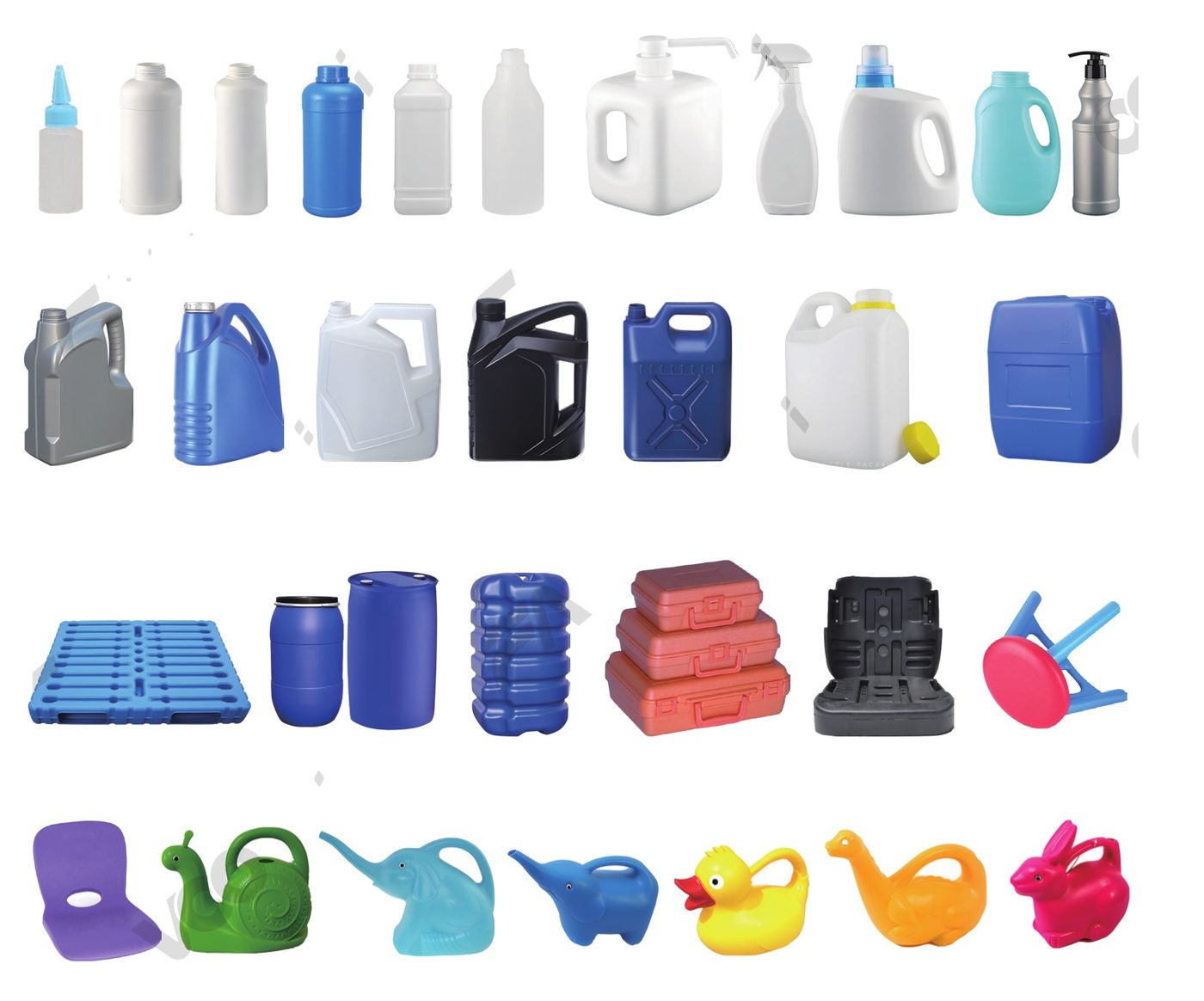
The screw runs constantly and the parison drops continuously; a shuttle or moving mould carriage takes a length of parison away to be blown. This is the workhorse for bottles and cans. Our extrusion blow moulding range covers hollow products from 0.1 ml up to 30 L in several clamping structures: pneumatic machines for 1–5 L, hydraulic three-platen machines for 1–12 L, toggle-arm clamping for 0.5–30 L and all-electric machines for 1–30 L. Multi-cavity die heads (2, 3, 4, 6 or 8 cavities) multiply output on small bottles.
Accumulator head
For large parts, a continuously falling parison would sag and cool before enough length was available. An accumulator (storage cylinder) head collects melt and then pushes it out quickly as one heavy parison. Our accumulator-head machines handle 20 L to 500 L products — drums, IBC tanks, water tanks, pallets, toolboxes, car parts, playground slides and road barriers — with accumulators of 3–30 L and clamping forces of 130–1,500 kN.
Strengths: handles and complex shapes, the widest size range, multi-layer and transparent view-stripe options, relatively affordable aluminium moulds. Limitations: flash on every part, neck finish less precise than an injection-moulded neck unless it is calibrated, and wall distribution relies on good parison control.
Injection blow moulding
Injection blow moulding machines use a rotary table with three stations. At station 1, plastic is injected around core rods inside a preform mould. The table rotates and, at station 2, the preforms (still on their core rods) are blown inside the blow mould. At station 3 the finished bottles are stripped off and ejected, and the core rods return to station 1.
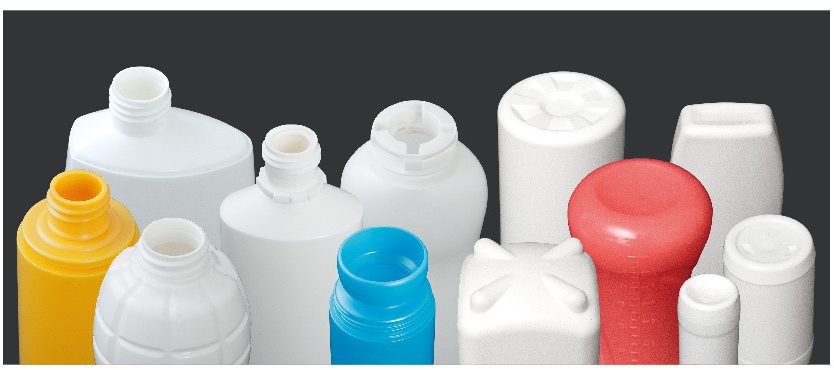
Because the neck is formed in the injection stage, IBM gives a precise neck finish for sealing, a smooth parting line and precise control of weight, wall thickness and volume. Bottles come out complete, with no flash and no scrap to trim — one reason the process is used for pharmaceutical containers that must meet GMP standards. The HassanPlas IBM range covers bottles from 1 ml up to 2 L (standard models list 5–800 ml) in PE, PP, PS, SAN, EVA, COC, PEEK, TPU, PETG and PLA.
Strengths: zero flash, best-in-class neck and weight accuracy, multi-cavity continuous automatic production, fast mould change. Limitations: no handles, a practical limit on bottle height and diameter (standard models allow around 190–220 mm height and 100 mm diameter), and three sets of tooling per cavity (preform mould, blow mould and core rods).
HassanPlas tip: If your product is a small HDPE or PP bottle that must seal reliably with a dropper, child-resistant cap or induction seal, ask for an injection blow moulding quotation alongside an extrusion one. The higher tooling cost often pays back through zero trimming, lower rejects and no regrind handling.
Two-stage PET stretch blow moulding
Two-stage (reheat) ISBM is how most water, carbonated soft drink and edible-oil bottles are made. PET preforms are injected on a dedicated injection moulding machine with a multi-cavity PET preform mould, cooled and stored. Later, a PET blow moulding machine passes the preforms through an infrared oven, then a stretch rod pushes each preform lengthways while high-pressure air expands it sideways. That biaxial orientation gives PET bottles their strength, clarity and gas barrier at a very low weight.
Strengths: the lowest cost per bottle at high volume, no flash, very light bottles, and the flexibility to buy preforms from the market if your injection side is down. Limitations: essentially PET only, no integral handles (clip-on handles are a separate part), two machines to buy and run, and preforms can scratch in storage and transport. We explain the preform versus blow machine split in detail in our guide to PET preform machines vs blow moulding machines.
Single-stage PET stretch blow moulding
A single-stage PET stretch blow moulding machine injects the preform, conditions it to the right temperature profile while it still holds heat from injection, then stretches and blows it — all in one machine. The preform never leaves the machine, so it is never scratched and never needs to be reheated from cold.
Strengths: excellent surface finish, suited to wide-mouth jars, oval and cosmetic shapes, and lower energy than reheating cold preforms. Neck finish is injection-moulded and precise. Limitations: output per machine is lower than a large two-stage line, and you are locked into making your own preforms. It suits cosmetics, personal care, pharmaceutical PET, food jars and medium-volume edible-oil bottles more than high-speed water lines.
Side-by-side comparison table
The table below summarises how the processes compare on the points buyers ask about most. Output and tooling cost are relative, because both depend heavily on bottle weight, cavitation and cycle time.
| Factor | EBM continuous | EBM accumulator | Injection blow moulding | Two-stage PET ISBM | Single-stage PET ISBM |
|---|---|---|---|---|---|
| Main materials | HDPE, PP, multi-layer | HDPE, multi-layer | PE, PP, PS, SAN, EVA, COC, PEEK, TPU, PETG, PLA | PET | PET (some machines also PP, PETG) |
| Size range | 0.1 ml – 30 L | 20 L – 500 L | 1 ml – 2 L (standard 5–800 ml) | Small bottles to large water bottles | Small to medium bottles and jars |
| Integral handle | Yes | Yes | No | No | No |
| Neck precision | Good (calibrated neck) | Adequate for bungs and caps | Excellent | Excellent | Excellent |
| Flash / trim scrap | Yes, reground | Yes, reground | None | None | None |
| Tooling cost | Low to medium | Medium to high (large moulds) | High per cavity | Preform mould high, blow mould medium | High (preform + blow + conditioning tooling) |
| Typical output | Medium to high with multi-cavity heads | Low (heavy parts, long cycles) | High for small bottles | Highest | Low to medium |
| Transparency | Opaque or translucent; view stripe possible | Opaque; view stripe possible | Clear with PS, SAN, PETG | Crystal clear | Crystal clear |
| Typical products | Milk, detergent, lube oil, pesticide bottles, jerry cans | Drums, IBC tanks, water tanks, pallets, car parts | Pharma, eye-drop, tablet, cosmetic, small personal care bottles | Water, CSD, juice, edible oil | Cosmetic jars, wide-mouth food jars, specialty PET |
Injection blow moulding vs extrusion blow moulding
For PET, the choice is between the two stretch processes. The genuinely difficult call is for small HDPE and PP bottles between roughly 10 ml and 1 L, where both injection blow moulding and extrusion blow moulding can make the part. This is how we weigh injection blow moulding vs extrusion blow moulding with our customers:
- Neck critical? Droppers, nasal sprays, child-resistant closures and induction-sealed pharma bottles favour IBM. An injection-moulded neck is dimensionally consistent cavity to cavity.
- Handle or offset neck? Only EBM can do it. IBM bottles must be strippable from a straight core rod.
- Weight and volume consistency? IBM controls weight and wall thickness more tightly because the preform is fully injected. EBM depends on parison programming and stable extrusion.
- Clean room or GMP? IBM produces no flash, no trimming dust and no regrind, which simplifies a clean production area. An all-electric IBM machine goes further by eliminating hydraulic oil.
- Frequent design changes or low volumes? EBM aluminium moulds are cheaper and quicker to make. IBM needs a matched set of preform mould, blow mould and core rods for every cavity.
- Above 1 L? EBM becomes the natural choice. IBM reaches 2 L on larger models, but the economics and machine size climb quickly.
Rule of thumb: under 1 L, no handle, tight neck tolerance, regulated market — injection blow moulding. Any handle, above 1 L, or HDPE with a view stripe or barrier layer — extrusion blow moulding. PET and clear — stretch blow moulding.
Which blow moulding machine? A decision flow
Work through these questions in order. The first one that matches your container usually decides the process.
- Is the container PET and does it need glass-like clarity? Go to question 2. If not, go to question 4.
- Will you produce high volumes of a few standard bottles (water, soft drinks, juice, edible oil)? Choose two-stage ISBM: a preform injection machine with a preform mould plus a reheat blow moulding machine. Start with bought-in preforms if budget is tight.
- Is it a cosmetic bottle, a wide-mouth jar, an oval shape or a medium-volume specialty bottle where surface finish matters? Choose single-stage ISBM.
- Is the container 20 L or larger (drums, IBC tanks, water tanks, pallets, large technical parts)? Choose an accumulator-head extrusion blow moulding machine.
- Does the container need a handle, or is it a jerry can, a lubricant bottle or a detergent bottle up to 30 L? Choose continuous extrusion blow moulding, sized by volume and clamping type.
- Does it need a barrier layer (pesticides, some foods) or a transparent level stripe (engine oil)? Choose extrusion blow moulding with a multi-layer or view-stripe die head.
- Is it a small bottle (roughly 1 ml to 1 L) with a critical neck, for pharma, eye care, cosmetics, diagnostics or nutraceuticals? Choose injection blow moulding.
- Still unsure? Send HassanPlas a drawing or a sample. We will compare the realistic options with machine size, mould cavitation, auxiliaries and indicative output.
Do not forget the closure. Whatever process you choose, the cap still has to be made. Most bottlers either buy caps or add a cap compression moulding machine or an injection machine with a cap mould; plan the cap and neck finish together.
Common mistakes when choosing a process
- Choosing the machine before freezing the container. Neck finish, handle, weight and volume decide the process. Finalise the bottle drawing first, then the machine.
- Forcing PET into an extrusion machine to "save money". Extrusion-grade PETG exists, but standard bottle-grade PET belongs in a stretch blow process. Mixing the two leads to poor clarity and brittle bottles.
- Using EBM for a precision pharma neck without a calibrated neck mould. The result is leakers and complaints from the filling line. Either specify neck calibration properly or switch to IBM.
- Underestimating flash. On some EBM parts, flash can be a significant share of the shot weight. Budget a granulator, regrind handling and the deflashing station from the start.
- Buying too small a clamping or platen size. In both IBM and EBM, mould space and clamping force limit cavitation. A slightly larger machine often doubles the future output you can reach by adding cavities.
- Ignoring auxiliaries. Every blow process needs chilled water, compressed air and usually a mould temperature controller and dryer. See our auxiliary equipment range.
Frequently asked questions
What are the main blow moulding process types?
There are four main types: extrusion blow moulding (continuous or accumulator head), injection blow moulding, two-stage PET injection stretch blow moulding (reheat) and single-stage PET injection stretch blow moulding. Each suits different materials, sizes and container designs.
What is the difference between injection blow moulding and extrusion blow moulding?
Injection blow moulding injects a preform onto a core rod and then blows it, giving a precise neck and no flash, but it cannot make handles. Extrusion blow moulding blows an extruded parison, can make handles and much larger containers, but produces flash that must be trimmed and reground.
Which blow moulding machine is best for jerry cans?
Jerry cans with handles are made on extrusion blow moulding machines. Continuous extrusion machines with toggle or hydraulic clamping cover cans up to 30 L, while accumulator-head machines are used for drums and containers from 20 L upwards.
Can injection blow moulding make PET bottles?
Standard injection blow moulding does not stretch the preform, so it is not used for typical bottle-grade PET. It does process PETG, along with PE, PP, PS, SAN, EVA, COC, PEEK, TPU and PLA. For clear PET bottles, use single-stage or two-stage stretch blow moulding.
Should I choose single-stage or two-stage PET stretch blow moulding?
Two-stage is better for high volumes of standard water, soft drink and edible-oil bottles because it has the lowest cost per bottle. Single-stage suits cosmetic bottles, wide-mouth jars and medium-volume specialty PET where surface finish and design flexibility matter more than top speed.
Which blow moulding process produces the least scrap?
Injection blow moulding and both stretch blow moulding processes produce no flash, so trimming scrap is essentially zero apart from start-up and rejects. Extrusion blow moulding always produces pinch-off flash, which is normally granulated and reused.
Not sure which process fits your container?
Send HassanPlas your bottle drawing or sample, target output and material. Our Lahore and Taizhou teams will recommend the process, machine and mould and send a quotation within 48 hours. WhatsApp +92 321 4466539 or email hassanplas@gmail.com.
Request a Quote →