An injection blow moulding machine is the standard tool for small, precise, flash-free bottles: tablet and capsule containers, eye-drop and nasal-spray bottles, syrup bottles, vials, roll-on and cosmetic bottles, and diagnostic containers. If your bottle is small, has no handle and needs a neck that seals perfectly every time, this is the process to evaluate first.
This guide is written for buyers who have decided (or nearly decided) on injection blow moulding and now need to specify a machine. It covers how the machine works, how to size it from your bottle, how many cavities to plan, the trade-offs between hydraulic, hybrid and all-electric platforms, what goes into the mould set, and the auxiliary equipment that completes the line. If you are still choosing between processes, start with our comparison of blow moulding process types.
How an injection blow moulding machine works
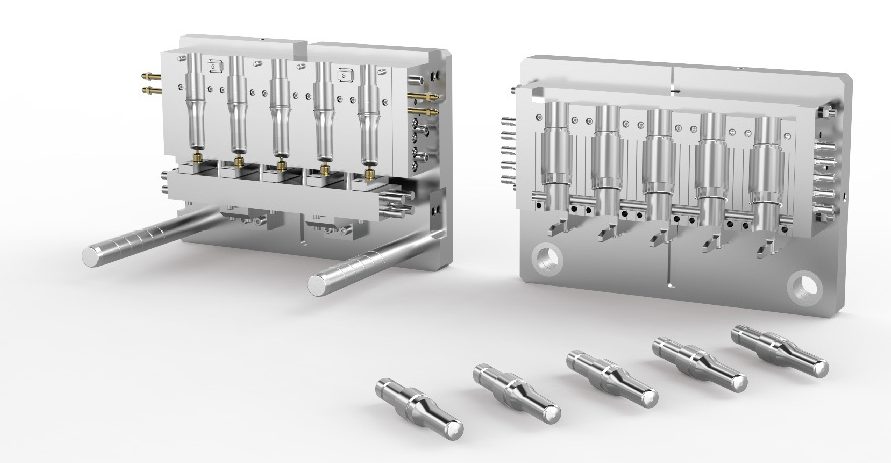
Our IBM range uses a rotary three-station design. A horizontal indexing table carries sets of steel core rods between three stations:
- Station 1 — preform injection. The core rods sit inside the preform mould. Molten plastic from the injection unit fills the cavities around the rods, forming preforms with a fully finished neck.
- Station 2 — blowing. The table lifts and rotates the hot preforms, still on their core rods, into the blow mould. Air passes through the core rods and inflates each preform against the cavity wall, where it cools.
- Station 3 — stripping and ejection. The finished bottles are stripped off the core rods and ejected, typically on to a conveyor. The empty rods rotate back to station 1 and the cycle repeats.
All three stations work at the same time, so every index of the table produces a full set of bottles. Because the preform is injected rather than extruded, there is no pinch-off and therefore no flash to trim.
Why pharma and cosmetic brands choose IBM
- One-step moulding with no flash or scrap, meeting GMP standards. No trimming station, no trimming dust and no regrind loop to validate.
- Precise neck finish for sealing. The neck is injection-moulded, so droppers, plugs, child-resistant caps and induction seals fit consistently.
- Smooth parting line with no pinch-off scar on the base, which matters for premium cosmetic presentation and for labelling.
- Precise weight, wall thickness and volume. Fill volume and container weight stay tight from cavity to cavity and shot to shot.
- Multi-cavity continuous automatic production, with bottles ejected oriented and ready for conveying, inspection or packing.
- Fast mould change between products, useful for contract moulders running many bottle sizes.
Materials and bottle size limits
Our IBM range processes PE, PP, PS, SAN, EVA, COC, PEEK, TPU, PETG and PLA. HDPE and PP dominate pharma solid-dose and liquid packaging; LDPE and EVA give squeezable bottles; PS, SAN and PETG give clarity; COC suits demanding medical and diagnostic applications; PLA answers bio-based packaging briefs.
Size limits are set by the core-rod geometry and the machine's mould space:
| Platform | Bottle volume | Max bottle height | Max bottle diameter | Notes |
|---|---|---|---|---|
| Compact high-speed model | 5–100 ml | 88 mm | 36 mm | 1.8 s dry cycle; eye-drop, vial and sample bottles |
| Standard models | 5–800 ml | 190–220 mm | 100 mm | Most pharma and cosmetic bottles |
| D-series (larger containers) | Larger containers, e.g. 1 L | Confirmed per model and design | Pesticide and chemical bottles with wide necks | |
| Full range | 1 ml – 2 L | Varies by model | Preform clamping force 323–2,000 kN | |
HassanPlas tip: The bottle must strip off a straight core rod, so handles and very wide shoulders relative to the neck are not possible. The ratio between body diameter and neck bore also limits how far the preform can be blown. Send us your drawing early — we check blow ratio and stripping before quoting.
How to size the machine
Machines in the range are referred to by class (30-class, 50-class and so on), with larger classes offering more clamping force and mould space. To choose one, work through four checks:
- Shot weight. Multiply the bottle weight by the number of cavities. A 16 g bottle in 8 cavities is a 128 g shot, plus a margin. The injection unit must deliver that weight comfortably in the chosen material.
- Preform clamping force. Clamping force must resist the injection pressure acting over the projected area of all preforms and the hot runner. Across our range this runs from 323 kN to 2,000 kN.
- Platen and table size. The length of the moulds along the table determines how many cavities fit at your bottle diameter. This, more often than shot weight, is what limits cavitation.
- Bottle height and diameter. Check the bottle against the model's maximum height and diameter, and confirm the core-rod length is within the machine's limit.
Then set a target output. Output per hour equals cavities × 3,600 ÷ cycle time in seconds. Cycle time is driven mainly by wall thickness and cooling, not by the machine's dry cycle, so ask for an estimated production cycle on your bottle, not the brochure dry-cycle figure.
Cavitation planning: a 100 ml worked example
Take a typical 100 ml tablet container: 34 mm neck, 47 mm body diameter, 78 mm tall, 16 g. Here is how many cavities fit on each machine class in our range, and the resulting shot weight:
| Machine class | Cavities (100 ml, 16 g) | Bottle weight per shot |
|---|---|---|
| 30-class | 5 | 80 g |
| 50-class | 8 | 128 g |
| 70-class | 11 | 176 g |
| 95-class | 13 | 208 g |
| 135-class | 18 | 288 g |
The jump from 5 to 18 cavities more than triples output per cycle, but each cavity carries its own preform cavity, blow cavity and core rod, so mould cost rises roughly in step with cavitation. The right answer depends on your annual volume, how many different bottles you run, and whether you plan to add products later.
For larger containers, the D-series example shows the same logic. A 1 L pesticide bottle weighing 82 g with a 60 mm neck runs 4 cavities at 24±1 s (14,400 pieces per 24 hours), 6 cavities at 25±1 s (20,409 pieces per 24 hours) or 8 cavities at 26±1 s (26,584 pieces per 24 hours). Doubling the cavities from 4 to 8 adds only about two seconds to the cycle but lifts daily output by roughly 85%.
Decision rule: size the machine for the cavitation you expect to need in year three, then buy the mould for today's volume. Upgrading a mould on a machine with spare table length is cheap; replacing an undersized machine is not.
Hydraulic vs hybrid vs all-electric
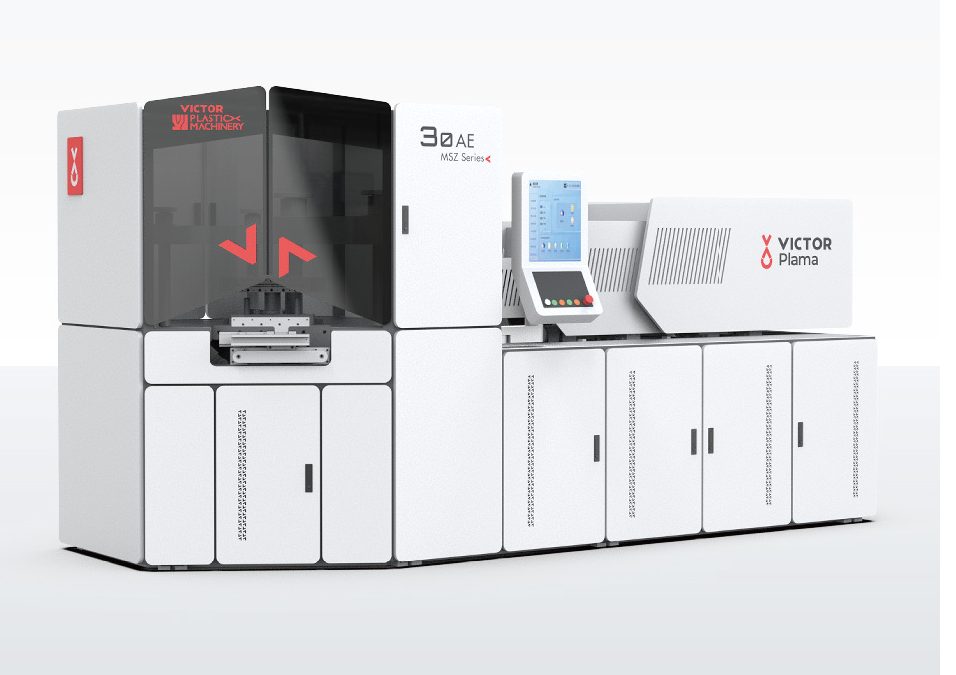
The HassanPlas IBM range comes on four platforms. Three of them are a choice of drive technology for the same job.
Standard hydraulic
The proven option, with more than 4,000 machines operating worldwide. A patented synchronous mould open/close and table-lifting mechanism keeps the dry cycle as low as 2 s. Lowest purchase price and simplest maintenance for most plants.
Hybrid
Combines a servo motor and ball screw with electric table rotation, electric charging (plasticising) and electric stripping. On a 5-cavity, 23.6 g, 200 ml HDPE bottle, the hybrid 50-class model used 0.45 kWh/kg against 0.53 kWh/kg for its hydraulic equivalent — about 14–15% less, or roughly 80 kWh saved for every 1,000 kg of bottles produced.
All-electric
No hydraulic oil, which makes it clean-room friendly. On a 150 ml HDPE round bottle (9 cavities, 21 g), moving from the hydraulic machine to the all-electric one gave these results:
| Metric | Hydraulic | All-electric | Change |
|---|---|---|---|
| Cycle time | 16.4 s | 14 s | −2.4 s |
| Output | 1,975 pcs/h | 2,314 pcs/h | +339 pcs/h |
| Energy per 100,000 bottles | 978 kWh | 705.6 kWh | −27.9% |
| Time per 100,000 bottles | 50.6 h | 43.2 h | −14.6% |
D-series
A platform for larger containers such as the 1 L pesticide bottle above, where bigger bottle dimensions and wide necks call for more mould space than the small-bottle models are built around.
How to choose: hydraulic where electricity is cheap and the budget is tight; hybrid where power cost matters but oil in the plant is acceptable; all-electric for GMP clean rooms, high electricity tariffs or unstable power where faster cycles and lower consumption pay back. In markets with expensive grid power or diesel back-up, run the kWh numbers before deciding — the saving compounds every shift.
IBM moulds: what you are actually buying
An IBM mould is a matched system, and every element must be right for the bottle to run:
- Preform mould with a hot runner manifold and nozzles feeding each cavity. Its design sets wall distribution in the finished bottle.
- Core rods, one per cavity per station set, with internal air channels and a blow valve at the tip. Core-rod temperature control and surface finish are critical.
- Blow mould cavities that give the final shape, engraving and texture, with cooling channels sized for the cycle.
- Stripper plate or bar that removes finished bottles from the rods at station 3.
- Neck rings and preform design. The preform is engineered backwards from the bottle, which is where experienced mould design pays for itself.
IBM moulds can also be built for Jomar and Uniloy machines, so a plant already running those platforms can source tooling through HassanPlas. Ask for mould steel specification, hardness, hot-runner make and spare core rods in the quotation. For mould sourcing more generally, see our moulds overview.
GMP and clean-room production
For pharmaceutical bottles, the machine is part of a validated process. IBM helps because there is no flash, no trimming and no regrind. To build a GMP-friendly cell, buyers usually:
- Choose an all-electric machine to remove hydraulic oil from the clean area.
- Specify stainless-steel or covered conveyors and enclosed hoppers.
- Place the chiller, compressor and dryer outside the clean room, piping services in.
- Add vision inspection and automatic bagging so bottles are not handled by operators.
- Agree at the order stage what machine documentation you need to support your installation and operational qualification (IQ/OQ).
Auxiliary equipment for an IBM line
A machine and mould alone will not run. A complete line usually includes the following, all of which we can supply from our auxiliary equipment range:
- Mould temperature controller(s) for the preform mould and core rods — essential for stable wall distribution.
- Chiller for blow-mould cooling and hydraulic oil cooling (on hydraulic machines).
- Air compressor, air dryer and filtration for blowing air.
- Automatic loader and colour mixer/doser for masterbatch.
- Resin dryer for hygroscopic materials such as PETG and PLA.
- Vision inspection for neck defects, contamination and short shots.
- Leak tester for containers that carry liquids.
- In-mould labelling where the label must survive sterilisation or wiping.
- Counting and bagging for clean, traceable packing.
Floor preparation, power and services should be ready before the machine lands; our factory preparation guide covers the checklist.
Injection blow moulding machine price factors
Two quotes for "a 50-class IBM machine" can differ widely. The main injection blow moulding machine price factors are:
- Drive type: hydraulic is the lowest purchase price, hybrid sits in the middle and all-electric costs the most up front but the least to run.
- Machine class: larger clamping force and table length cost more but allow more cavities.
- Mould cavitation and complexity: often a large share of the total project cost. Oval bottles, engraving and tight-tolerance pharma necks add cost.
- Component brands for PLC, servo drives, hydraulics and hot runner.
- Auxiliaries and automation: vision, leak testing, labelling and bagging can add significantly.
- Freight, installation and training, which depend on your country and site readiness.
Because of these variables, we do not publish a single price. HassanPlas quotes the machine, mould and line together so you can compare like for like. Our guide on how to buy machinery from China explains how to read and compare quotations.
Frequently asked questions
What size bottles can an injection blow moulding machine make?
The HassanPlas IBM range covers bottles from 1 ml up to 2 L. Standard models are listed for 5 to 800 ml with a maximum bottle height of 190 to 220 mm and maximum diameter of 100 mm. A compact high-speed model handles 5 to 100 ml bottles up to 88 mm tall and 36 mm in diameter.
Why is injection blow moulding used for pharma bottles?
It produces bottles in one step without flash or scrap, meeting GMP standards. The injection-moulded neck gives a precise finish for sealing, and weight, wall thickness and volume are tightly controlled. All-electric machines also remove hydraulic oil from clean rooms.
How many cavities can I run on an IBM machine?
It depends on bottle size and machine class. For a 100 ml, 16 g tablet container with a 47 mm body, our range fits 5 cavities on the 30-class, 8 on the 50-class, 11 on the 70-class, 13 on the 95-class and 18 on the 135-class machine.
Is an all-electric injection blow moulding machine worth the extra cost?
In our 150 ml HDPE example with 9 cavities, the all-electric machine cut cycle time from 16.4 s to 14 s, raised output from 1,975 to 2,314 pieces per hour and reduced energy per 100,000 bottles by 27.9 percent. Where power is expensive or clean-room production is required, the saving usually justifies it.
Can injection blow moulding make bottles with handles?
No. The bottle has to strip off a straight core rod, so integral handles are not possible. Handled containers are made by extrusion blow moulding.
Can HassanPlas supply moulds for existing Jomar or Uniloy machines?
Yes. IBM moulds, including preform moulds, blow moulds and core rods, can be built for Jomar and Uniloy machines as well as for our own IBM range.
Planning an injection blow moulding line?
Send HassanPlas your bottle drawing, material and annual volume. We will recommend the machine class, drive type and cavitation, and quote the machine, mould and auxiliaries within 48 hours. WhatsApp +92 321 4466539 or email hassanplas@gmail.com.
Request a Quote →