An extrusion blow moulding machine turns HDPE or PP pellets into hollow containers by extruding a soft tube (the parison), clamping a mould around it and blowing it to shape. It is the process behind milk and juice bottles, detergent and shampoo bottles, engine-oil and lubricant bottles, pesticide bottles, jerry cans, drums, IBC tanks, water tanks and many large technical parts.
The challenge for buyers is that "EBM machine" covers equipment ranging from a compact pneumatic unit for 1 L bottles to a heavy accumulator-head machine for 500 L parts. This guide explains how to narrow that down using real figures from our extrusion blow moulding range, which HassanPlas sources and supports from our Taizhou office. If you are still comparing processes, read blow moulding process types compared first.
How an extrusion blow moulding machine works
- Plasticising. A single-screw extruder (in our standard table, 55–120 mm screw diameter with an L/D of 25:1) melts and homogenises the resin, regrind and masterbatch.
- Parison forming. Melt flows through the die head and exits as a vertical tube. Die tooling (die and mandrel) sets the parison diameter and wall.
- Mould clamping. The mould halves close on the parison, pinching off the bottom and sealing it. A knife or hot cutter separates the parison.
- Blowing. A blow pin or needle introduces compressed air; the parison expands against the cooled mould.
- Cooling and ejection. After cooling, the mould opens and the part is removed — manually, by a robot arm or on to a conveyor.
- Deflashing. Top, bottom and handle flash is removed, usually automatically, and granulated for reuse.
Continuous extrusion vs accumulator head
The most important architectural choice is how the parison is delivered.
Continuous extrusion
The extruder runs non-stop and the parison drops at a steady rate. The mould carriage shuttles under the die head to collect a length of parison, then moves aside to blow it while the next length forms. This is efficient for bottles, cans and containers up to around 30 L, and multi-cavity die heads multiply output on smaller items.
Accumulator head (storage cylinder)
For large parts, a continuously falling parison would stretch under its own weight and cool unevenly before enough length existed. An accumulator head stores melt in a cylinder, then a ram pushes it out quickly as one heavy parison. Our accumulator-head machines cover 20 L to 500 L products with accumulator volumes of 3–30 L, clamping forces of 130–1,500 kN, HDPE melting capacity of 80–300 kg/h and total installed power of 65–220 kW. They can produce 1–6 layer products and use servo energy-saving drives.
Decision rule: up to about 30 L, choose continuous extrusion. From 20 L upwards — drums, IBC tanks, water tanks, pallets and large technical parts — choose an accumulator head. In the 20–30 L overlap, the deciding factors are part weight, wall thickness and target output; send us the part weight and we will recommend one.
Choosing machine size by container volume
Machine size is normally named by the largest container it is designed to blow. The table below shows the spread of our standard continuous machines from 2 L to 60 L, followed by the accumulator range.
| Machine | Screw diameter | HDPE melting capacity | Clamping force | Total power |
|---|---|---|---|---|
| 2 L standard | From 55 mm (L/D 25:1) | 50–70 kg/h | From 50 kN | 40–43 kW |
| Up to 60 L standard | Up to 120 mm (L/D 25:1) | Up to 280 kg/h | Up to 365 kN | 120–130 kW |
| Accumulator head, 20–500 L | Sized per model | 80–300 kg/h | 130–1,500 kN | 65–220 kW |
Sizing is not just about volume. Check four things:
- Melting capacity versus shot weight and cycle. Hourly output in kg (part weight plus flash, multiplied by parts per hour) must sit comfortably below the extruder's melting capacity for your resin.
- Mould space and stroke. The mould must fit between the platens with room for the opening stroke; multi-cavity moulds widen the requirement.
- Clamping force. Enough to hold the mould shut against blow pressure and to pinch off thick parisons cleanly — critical on handles.
- Power supply. Total installed power from around 40 kW for a 2 L machine to over 200 kW for large accumulator machines affects transformer and generator sizing.
Clamping types: pneumatic, hydraulic, toggle, all-electric
Our standard range covers hollow products from 0.1 ml to 30 L in four clamping structures:
| Clamping type | Product range | Strengths | Best for |
|---|---|---|---|
| Pneumatic | 1–5 L | Light, compact, clean, oil-free, energy-saving | Small bottles, simple shapes, budget lines |
| Hydraulic three-platen | 1–12 L | Stable, large mould space, economical | Detergent and lubricant bottles, small cans |
| Toggle-arm | 0.5–30 L | Strong, uniform clamping; neat parting line | Jerry cans and handled containers needing clean pinch-off |
| All-electric | 1–30 L | High speed, low noise, oil-free | Food, dairy and personal care; high power-cost markets |
For a jerry can making machine in the 5–30 L range, toggle-arm clamping is a common choice because uniform clamping force gives a strong, neat handle pinch-off. Hydraulic three-platen machines suit cost-conscious lines up to 12 L. All-electric is worth considering when electricity is expensive or the product is food-contact and oil-free operation is preferred.
Die heads, cavities, layers and view stripes
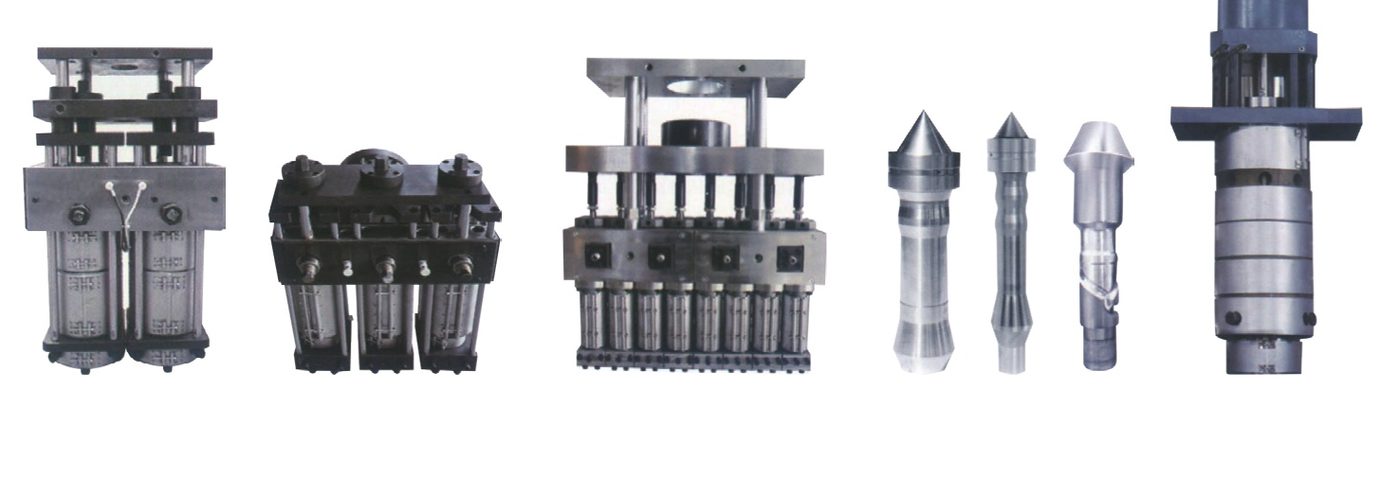
The die head defines what the machine can make. Options in our range include:
- Single-layer heads for standard HDPE and PP containers.
- Double-layer heads, for example a coloured outer layer over a recycled or differently coloured inner layer.
- Double-layer with transparent view stripe, giving a clear vertical strip so the user can see the fill level — standard on engine-oil and lubricant bottles.
- Three-layer heads for barrier structures, such as multi-layer pesticide bottles.
- Multi-cavity heads with 2, 3, 4, 6 or 8 cavities that produce several parisons at once for small bottles.
For lubricant, fuel and detergent bottles of 1–12 L, a dedicated engine-oil bottle machine uses a streamlined die head with no dead angles in the flow path, which shortens colour changes and reduces degraded-material streaks.
Parison wall-thickness control
A parison of constant wall thickness does not produce a container of constant wall thickness. Corners, handles and the base stretch more than flat panels, so they come out thin. A parison wall-thickness controller varies the die gap as the parison is extruded, adding material exactly where the part needs it.
The benefits are direct: lower part weight for the same drop and stacking performance, fewer thin-corner failures and more consistent quality between shifts. On drums and jerry cans, where every gram multiplies across thousands of parts, the controller is one of the fastest-paying options on the machine. We recommend it on almost every container above a few litres.
HassanPlas tip: When comparing quotations, check whether the parison controller, servo pump and automatic deflashing are included or optional. Two machines with the same headline size can differ greatly once these are added, and leaving them out usually costs more in resin and labour than it saves.
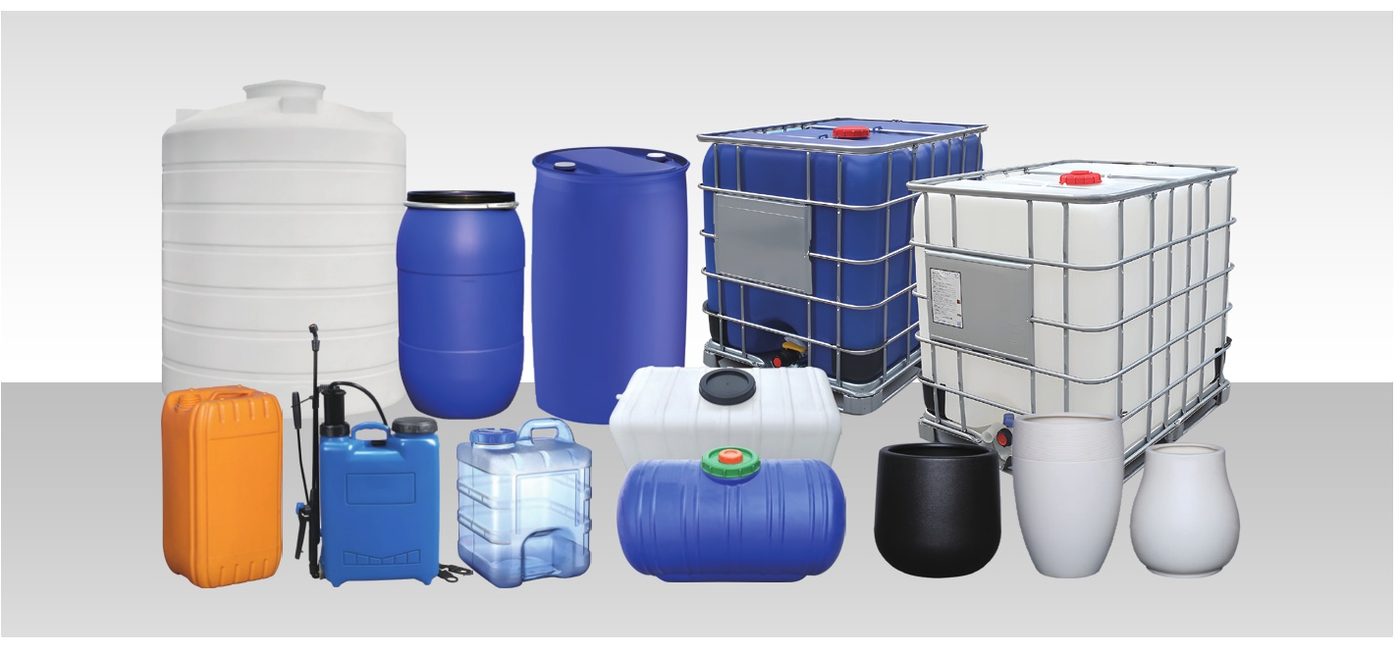
Product examples: from lube oil to IBC tanks
Lubricant and engine-oil bottles (1–12 L)
Usually HDPE with a transparent view stripe and a handle. The dedicated engine-oil bottle machine with a no-dead-angle die head is designed for this market, which also covers fuel and detergent bottles.
Pesticide and agrochemical bottles
Many agrochemicals need a barrier layer to limit permeation and panelling. Our multilayer pesticide bottle machine builds the barrier into the wall in one step.
Detergent, shampoo and household bottles
HDPE or PP, often with handles and offset necks, made on hydraulic three-platen, toggle or all-electric machines with multi-cavity heads for smaller sizes.
Jerry cans (5–30 L)
HDPE cans for edible oil, chemicals, water and fuel. Toggle-arm machines are a strong fit, with the parison controller to keep handle and corner walls even.
HDPE drums (20–220 L)
An HDPE drum blow moulding machine is an accumulator-head machine. Tight-head (L-ring) and open-head drums both depend on accurate parison control and strong clamping to form thick, even walls.
IBC tanks, water tanks and large parts
IBC tanks, water tanks, pallets, toolboxes, car parts, playground slides, road barriers and hospital-bed panels are produced on the larger accumulator-head models. Tell us the exact volume, weight and dimensions and we confirm the model and mould size.
Options, auxiliaries and energy
Options available on our extrusion blow moulding range include electric mould shifting, a servo oil pump, the parison wall-thickness controller, a transparent view-stripe line, in-mould labelling, a leak tester, automatic deflashing, a robot arm and conveyors. Key components come from established international brands including Moog, Siemens, Mitsubishi, Festo, SMC, Gefran, Delta, Yuken, AirTAC, Rexroth, Schneider and Hiwin, which also simplifies sourcing spare parts locally.
Around the machine, a complete line normally needs a chiller for mould cooling, an air compressor with dryer and receiver, an automatic loader and colour mixer, and a granulator for flash. All are available from our auxiliary equipment range. Caps and closures are a separate line — see cap moulds if you plan to make your own.
Energy. Extrusion heating and hydraulics are the largest consumers. Servo-driven hydraulic pumps run only when motion is required instead of circulating oil continuously, and all-electric machines remove the hydraulic system altogether. On large accumulator machines with total installed power up to 220 kW, specifying servo drives is usually a straightforward payback decision.
Common defects and how to avoid them
| Defect | Typical cause | Prevention |
|---|---|---|
| Thin corners or handle walls | Uniform parison wall, high local stretch | Parison wall-thickness controller; adjust die tooling |
| Weak or leaking pinch-off | Low clamping force, worn pinch edges, cold parison | Correct clamping type and force; maintain mould pinch areas |
| Parison sag or curtaining | Melt too hot, slow extrusion on heavy parts | Use an accumulator head for large parts; tune melt temperature |
| Die lines and streaks | Contamination, degraded material, dead spots in die | Clean die; streamlined die head; dry, clean regrind |
| Rocker bottom or warpage | Uneven cooling, early ejection | Balance mould cooling; adequate chiller capacity |
| Neck leaks | Poor neck calibration or flash at the neck | Calibrated neck tooling; check deflashing; leak tester |
| Misaligned view stripe | Die head setting, parison rotation | Set-up during commissioning; stable extrusion |
Most of these defects are decided at the specification stage — machine type, die head and options — rather than on the shop floor. HassanPlas engineers review the drawing, check machine and mould choice, and support installation, commissioning and operator training so the line starts with good parts. Our factory preparation guide lists what to have ready before the machine arrives.
Frequently asked questions
What size containers can an extrusion blow moulding machine make?
Our standard continuous machines cover hollow products from 0.1 ml to 30 L, with a standard machine table running from 2 L to 60 L. Accumulator-head machines cover 20 L to 500 L for drums, IBC tanks, water tanks and large parts.
Which machine is best for making jerry cans?
For 5 to 30 L jerry cans, a continuous extrusion blow moulding machine with toggle-arm clamping is a common choice because it gives strong, uniform clamping and a neat pinch-off on the handle. A parison wall-thickness controller keeps corners and handles evenly thick.
Do I need an accumulator head for HDPE drums?
Yes. Drums from 20 L up to 220 L need a heavy parison delivered quickly, which is what an accumulator head does. Our accumulator machines offer 3 to 30 L accumulators, 130 to 1,500 kN clamping and 80 to 300 kg/h HDPE melting capacity.
What is a view stripe and when do I need one?
A view stripe is a transparent vertical strip extruded into an otherwise opaque container so the user can see the liquid level. It is standard on engine-oil and lubricant bottles and needs a double-layer die head with a view-stripe line.
Can extrusion blow moulding make multi-layer bottles?
Yes. Die heads are available in single-layer, double-layer and three-layer versions, and accumulator machines can produce 1 to 6 layer products. Multi-layer structures are used for pesticide bottles and other products that need a barrier.
How can I reduce energy use on an extrusion blow moulding machine?
Specify a servo oil pump or an all-electric machine, use a parison wall-thickness controller to cut part weight, and size the chiller and compressor correctly. Servo energy-saving drives are standard on our accumulator-head range.
Need a quote for bottles, jerry cans or drums?
Send HassanPlas your container volume, weight, sample or drawing and target daily output. We will recommend the machine, die head, mould and auxiliaries and send a quotation within 48 hours. WhatsApp +92 321 4466539 or email hassanplas@gmail.com.
Request a Quote →