If you are buying a cap compression moulding machine or a multi-cavity injection mould for caps, you are choosing between two mature, proven processes that produce caps which look almost identical on the shelf. The differences are in how the plastic is formed, how much scrap is generated, how light the cap can be made, how quickly you can change products, and how much capital you tie up. This guide compares cap compression moulding (CCM) and injection moulding from the point of view of a bottler or closure maker deciding what to install, and it reflects what we see across the cap projects HassanPlas supplies to water, beverage, edible oil and pharma customers.
Two processes, one product
Most plastic bottle caps for water and soft drinks are one-piece HDPE (sometimes PP) closures with an internal thread, an integrated sealing feature (bore seal, olive or lip) and a tamper-evident band. Both processes can make that cap to the same neck finish and the same drawing. What differs is the route the polymer takes:
- Injection moulding melts the resin in a reciprocating screw, then injects a measured shot through a hot runner into all cavities at once. The mould opens, the caps are ejected, the cycle repeats.
- Compression moulding extrudes a continuous stream of melt, cuts it into individual doses (pellets of molten plastic), drops each dose into an open cavity and then squeezes the cavity shut to form the cap. There is no runner and no gate.
That single difference — injecting into a closed cavity versus compressing an open one — drives almost everything in the comparison below.
How a cap compression moulding machine works
A CCM machine is a continuous rotary system rather than a cyclic press. The sequence is:
- Continuous extrusion. A single-screw extruder plasticises HDPE or PP and pushes melt through a die at a steady rate. Masterbatch for colour is dosed at the throat.
- Dose cutting and placement. A rotating cutter slices the extrudate into doses of precise weight and transfers each one into a female cavity on the carousel. Dose weight is set by extruder output and carousel speed, so cap weight is controlled continuously rather than shot by shot.
- Rotary compression. The carousel carries many individual tool sets (commonly in the range of a few dozen on production machines). As it rotates, cams or hydraulic cylinders drive each punch into its cavity, forming the thread, the seal and the band under pressure.
- Cooling. Each tool set stays closed for most of the revolution while chilled water cools the cap. Because the melt was processed at a lower temperature and never flowed through a narrow gate, there is less heat to remove and less moulded-in stress.
- Ejection. The punch withdraws, the cap is stripped off the core and discharged by air or star wheel to the downstream conveyor, typically into slitting/folding and inspection.
Each cavity is effectively its own small mould. That matters for maintenance (one damaged tool set can be pulled while the rest keep running) and for cost (tooling is priced per station, not per block). SACMI is the best-known name internationally in this technology, and a number of Asian builders now offer rotary CCM machines for standard water and CSD caps. HassanPlas supplies cap compression moulding machines configured for the common water and beverage neck finishes.
HassanPlas tip: A CCM line is built around one cap family. Before ordering, freeze your cap drawing — neck finish, weight target, band design and liner-free seal geometry — with your bottle and capper suppliers. Changing the design after the tooling is cut is far more expensive on CCM than on injection.
How injection cap moulding works
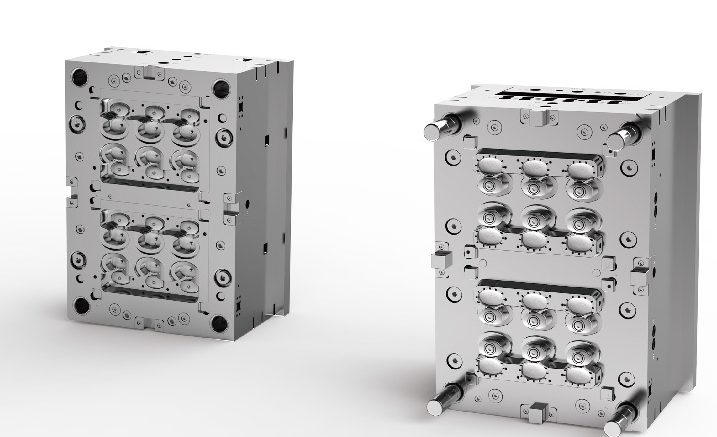
Injection cap moulding uses a standard or cap-dedicated injection moulding machine with a multi-cavity hot runner mould. The screw plasticises and injects, the mould cools the caps, and an ejection system releases them. Cavity counts from 8 up to 48 or more are common, and high-speed cap machines are optimised for fast dry cycles and high injection speed.
The hot runner keeps the plastic molten all the way to each gate, so there is no cold runner to regrind. The real engineering choice is how the cap is released from the threaded core:
Stripper (bump-off) ejection
A stripper ring pushes the cap off the core and the flexible PE thread deforms momentarily as it jumps over. This is the simplest, fastest and cheapest approach and is the standard for lightweight water and CSD caps with shallow threads. It only works when the thread profile and material can tolerate the deformation.
Unscrewing moulds
The cores rotate (driven by rack and pinion, hydraulic motor or servo) to unscrew the cap off the thread. Unscrewing is needed for deep or rigid threads, PP caps, child-resistant closures and many pharma and chemical caps. It adds cost and complexity but gives full freedom on thread design.
Collapsible cores
The core segments collapse inward to release internal undercuts or interrupted threads. They are used for larger closures and special features where neither stripping nor unscrewing is practical.
Injection can also mould features that compression cannot easily produce: hinged flip-tops, sports-cap spouts, dispensing orifices, and multi-component closures assembled after moulding. Our cap moulds range covers stripper, unscrewing and flip-top designs.
CCM vs injection moulding caps: side-by-side
The table below compares the two processes for a standard one-piece water or CSD cap. These are general tendencies; a well-built injection system will beat a poorly maintained CCM line and vice versa.
| Factor | Compression moulding (CCM) | Injection moulding |
|---|---|---|
| Scrap and runners | No runner, no gate, very low start-up scrap once stable | Hot runner eliminates cold runner scrap; purge and start-up scrap higher |
| Melt temperature | Lower — melt only needs to flow enough to be dosed | Higher — melt must flow through gates and fill thin sections fast |
| Energy per cap | Generally lower: lower melt temperature, continuous extrusion, no injection pressure peaks | Generally higher, though modern servo-hydraulic and all-electric machines narrow the gap |
| Cycle / output | Continuous; very high output from one machine on a single cap design | Cyclic; output scales with cavitation and cycle time |
| Cap weight / lightweighting | Excellent — thin walls without flow-length limits; dose weight finely adjustable | Good, but very thin walls are limited by flow length and injection pressure |
| Dimensional stability | Low moulded-in stress; consistent across stations | Good with balanced hot runner; more risk of orientation stress near the gate |
| Ovality | Typically very low, helps capping torque consistency | Low with good cooling; gate area can influence roundness |
| Gate mark | None — clean top panel, good for printing | Small gate vestige on top panel |
| Complex caps (flip-top, sports, CRC) | Not practical | Full flexibility |
| Mould cost | Priced per tool set; high total for a full carousel | Priced per mould block; wide range depending on cavities and ejection type |
| Changeover | Slow and costly; machine is usually dedicated to one cap family | Mould swap in hours; one machine can run many cap designs |
| Capital investment | Higher entry cost; justified only at sustained high volume | Lower entry cost; scalable by adding machines and moulds |
The practical summary: CCM wins on cost per cap at very high volume for a stable, simple cap; injection wins on flexibility, lower entry investment and anything with complex geometry.
Which caps suit which process
Neck finish and cap function usually decide the process before any cost calculation is done.
| Cap type | Typical neck finish | Best-fit process | Notes |
|---|---|---|---|
| Still water, short neck | 29/25, 30/25, 26/22 | CCM or injection | Lightweight caps; CCM attractive at high volume |
| Still water / CSD, standard | PCO 1881, PCO 1810 | CCM or injection | Highest-volume caps in the market; both processes widely used |
| Carbonated soft drinks | PCO 1881 / 1810 | CCM or injection | Must hold carbonation pressure; seal design and band performance critical |
| Juice, dairy, hot-fill | 38 mm | Injection (CCM possible for simple designs) | Often 2- or 3-start threads; some designs need unscrewing |
| Sports / push-pull caps | 1881, 38 mm | Injection | Multi-part assembly; needs assembly machine |
| Flip-top / hinged caps | Various | Injection | Hinge and orifice require injection; often in-mould closing |
| Edible oil caps | Various, often with pourer | Injection | Pourer spouts and tamper rings rule out CCM |
| 5-gallon (19 L) dispenser | 55 mm | Injection | Larger LDPE caps with tear strip; volumes lower than small caps |
| Pharma / child-resistant | Various | Injection (unscrewing) | Two-piece CRC designs and tight validation requirements |
| Wide-mouth jars | 48 mm and larger | Injection | Larger diameters, lower volume per SKU |
If your plan includes a range of these caps, injection will almost certainly be part of the answer.
Downstream equipment you will also need
The moulding machine is only one part of a cap plant. Whichever process you choose, budget and plan floor space for the following:
- Slitting and folding machine. Many water and CSD caps have the tamper-evident band connected to the cap by bridges that are cut by a slitting knife after moulding, and some designs need the band folded inward. CCM caps almost always go through slitting. Injection moulds can form bridges directly in the mould, but many high-volume injection caps are also slit, because it allows a stronger, simpler mould.
- Lining / wadding machine. Caps that need an extra seal — certain oil, chemical, pharma and some CSD closures — receive a compression-moulded or inserted liner (wad). Most modern water caps are liner-free, with the seal moulded into the cap.
- Printing. Top-panel printing for branding or dates. The gate-free top of a compression cap prints cleanly; injection caps with a small gate vestige print well too if the gate is recessed.
- Vision inspection. Camera systems check for short shots, flash, damaged bands, colour variation and contamination. At high output, manual inspection cannot keep up; plan for at least a basic vision system.
- Auxiliaries. Chiller, resin loaders, colour dosing and conveyors — sized for the full line. See our auxiliary equipment range.
Watch out: Cap and bottle neck must be engineered together. A cap that measures correctly on a gauge can still leak, back off or fail the tamper band test on a bottle neck from a different preform mould. Always validate new caps on the actual bottles and the actual capping head before approving the mould.
Decision rules by volume and product mix
We use these rules of thumb when advising cap buyers. They are starting points for a conversation, not hard thresholds — resin price, power tariff, labour and the cap design all move the break-even.
Rule 1: Many cap designs or colours, moderate volume → injection
If you supply several bottlers with different neck finishes, colours and band designs, or you make caps for your own range of water, juice and oil bottles, injection is the clear choice. One or two machines with interchangeable moulds give you flexibility that CCM cannot.
Rule 2: Captive cap supply for your own water line → usually injection
A mineral water bottler making caps for its own bottles typically needs far fewer caps than a CCM machine is designed to produce. A mid-cavity stripper mould on a fast cap injection machine matches the bottling line's output without stranding capacity.
Rule 3: One cap design, running continuously, very high annual volume → evaluate CCM
If you are a dedicated closure producer with contracts for one standard cap — typically 1881 or a short-neck water cap — that will keep a machine running around the clock for years, CCM's lower cost per cap, lighter achievable weight and lower energy use can justify the higher investment. Ask for a cost-per-thousand-caps model on your own resin price and power tariff before deciding.
Rule 4: Complex closures → injection, no debate
Flip-tops, sports caps, pourers, CRC and 5-gallon caps belong on injection.
Rule 5: Start with injection, add CCM when one SKU dominates
Many closure makers grow this way. Injection builds the customer base and product range; once one cap design reaches sustained high volume, a CCM line takes over that cap and the injection machines are freed for the rest of the range.
HassanPlas tip: When you compare quotations, convert everything to cost per 1,000 caps at your real utilisation: resin (cap weight × resin price), electricity, labour, tooling depreciation and scrap. A 0.2 g saving per cap often matters more over a year than a difference in machine price. We can prepare this model for both processes from your cap drawing.
Common buying mistakes
- Buying CCM for volume you do not yet have. A CCM machine running a single shift is an expensive way to make caps. Utilisation is everything.
- Choosing a mould without a cap drawing. Asking for "1881 cap mould" is not enough. Weight, seal design, band style and material grade must be agreed in writing.
- Ignoring the slitting machine. Buyers sometimes discover after delivery that their cap design requires slitting and folding. Confirm this at the quotation stage.
- Mismatching cap and preform neck. The neck finish on your PET preform mould and the cap mould must come from the same standard and tolerance set. See our PET preform mould buying guide for neck finish selection.
- Under-sizing cooling. An under-sized chiller is a common cause of ovality and slow cycles in both processes.
- Skipping trial approval. Approve the mould only after caps pass torque, leak and tamper-band tests on your real bottles.
If you are also planning the bottle side of the plant, read our guide on starting a PET bottle manufacturing plant, which covers how a cap line fits into a complete water or beverage project.
Frequently asked questions
What is a cap compression moulding machine?
A cap compression moulding machine (CCM or CCMM) extrudes plastic continuously, cuts it into measured doses, places each dose into an open cavity on a rotating carousel and compresses it into a finished cap. There is no runner or gate, so scrap is very low and caps can be made lighter than by most injection systems.
Is compression moulding better than injection moulding for bottle caps?
It depends on volume and cap design. Compression moulding usually gives lower cost per cap, lower energy use and lighter caps for one simple design running at very high volume. Injection moulding is better for multiple cap designs, moderate volumes and complex caps such as flip-tops, sports caps and child-resistant closures.
Can a compression moulding machine make flip-top caps?
No, not in practice. Flip-top, hinged, sports and dispensing caps need injection moulding because their hinges, spouts and orifices cannot be formed by compressing a single dose in an open cavity.
Which bottle cap making machine is best for a mineral water plant?
For a bottler making caps for its own water line, a multi-cavity stripper mould on a fast injection moulding machine is usually the best fit, because it matches bottling output without excess capacity. Compression moulding becomes attractive for dedicated closure producers running one cap design around the clock at very high annual volume.
Do I need a slitting machine for bottle caps?
Most compression-moulded water and CSD caps need a slitting machine to cut the tamper-evident band bridges, and some designs also need folding. Many injection-moulded caps are slit as well. Confirm whether your cap drawing requires slitting before you finalise the line.
What neck finishes can HassanPlas supply cap moulds and machines for?
HassanPlas supplies cap moulds and cap compression moulding machines for common neck finishes including PCO 1881, PCO 1810, 29/25, 30/25, 38 mm, 48 mm and 55 mm 5-gallon caps, along with custom designs built to your cap drawing.
Choosing between CCM and injection for your caps?
Send us your cap drawing or sample, neck finish and annual volume. HassanPlas will recommend the process, size the machine and moulds, and send a quotation within 48 hours. WhatsApp +92 321 4466539 or email hassanplas@gmail.com.
Request a Quote →