A PET preform mould is the most precise and most expensive piece of tooling in a PET bottle plant. It determines how many preforms you make per hour, how consistent their weight and wall thickness are, how much PET each bottle consumes, and how long you can run before maintenance. This guide explains the decisions behind a preform mould specification — cavitation, hot runner, neck finish, preform design, steel, cooling and machine compatibility — and what to check before you accept the mould. It is based on the preform mould projects HassanPlas supplies for water, CSD, edible oil and 5-gallon bottlers.
How many cavities should a preform mould have?
Cavitation is the first decision and it is a balance of three things: the output you need, the machine you have (or will buy), and your budget. Output is simple arithmetic:
Preforms per hour = cavities × 3,600 ÷ cycle time (seconds)
A 16-cavity mould on a 14-second cycle gives about 4,100 preforms per hour; a 48-cavity mould on a similar cycle gives around three times that. Cycle time depends mainly on wall thickness — thin-wall water preforms cool fast, thick 5-gallon preforms take much longer.
The machine must then be able to carry the mould. Check three limits:
- Shot weight: cavities × preform weight should sit comfortably inside the machine's shot capacity for PET — not at the very top, where melt residence and plasticising rate become a problem, and not so low that the melt sits in the barrel too long and degrades.
- Plasticising rate: the screw must melt the full shot within the cycle. High-cavity, fast-cycle moulds are often limited by plasticising rate rather than clamp force.
- Mould size: the mould must fit between the tie bars and within the platen, with enough opening stroke to eject long preforms.
Indicative pairings we see in practice (they vary with preform weight, pitch and machine design):
| Cavities | Typical clamp range (indicative) | Typical use |
|---|---|---|
| 1–4 | Smaller PET machines, or larger machines for heavy 5-gallon preforms | 5-gallon preforms, wide-mouth jars, trials and low volume |
| 8–16 | Roughly 150–300 T | Small and mid-size water bottlers, oil bottles, captive supply |
| 24–32 | Roughly 250–400 T | Established bottlers, preform sellers |
| 48 | Roughly 350–600 T | High-volume water and CSD preform production |
| 72–96 | Roughly 500 T and above | Large preform converters running 24/7 |
Our rule: size cavitation to your blow capacity plus planned growth, not to the biggest mould your budget allows. A mould that runs half the time costs nearly as much to own as one that runs all the time. If you are unsure how preform and blow capacity relate, read PET preform machine vs blow moulding machine.
Hot runner: valve gate vs open gate
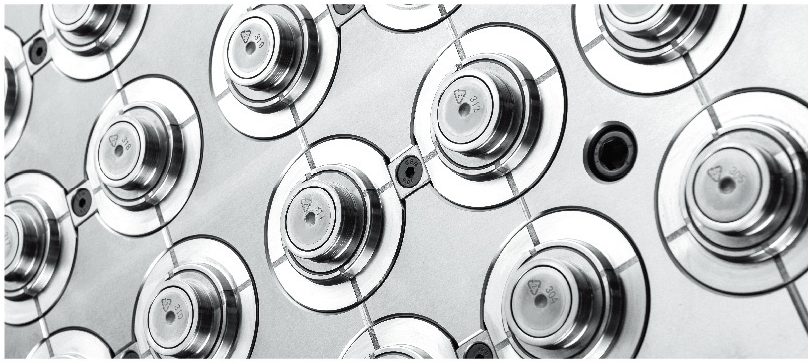
Every modern PET preform mould uses a hot runner: a heated manifold and nozzles that keep PET molten from the machine nozzle to each cavity gate. The main choice is how each gate is closed.
Valve gate
A pin, actuated pneumatically, physically closes each gate at the end of injection and holding. Benefits: a clean, small gate vestige, no stringing or drooling, better control of the crystallised gate area, consistent fill across cavities and more stable processing. Valve gates are the standard choice for high-cavity moulds and for any buyer who wants consistent preform quality. They cost more and need clean, dry actuation air and periodic pin and seal maintenance.
Open gate (thermal gate)
The gate is controlled by temperature alone — the nozzle tip freezes and re-melts each cycle. Benefits: lower cost and simpler maintenance. Drawbacks: higher risk of stringing, gate drool, a larger or whiter gate mark, and more sensitivity to tip temperature. Open gates can work well on low-cavity moulds and less demanding preforms, but they are a compromise on high-volume work.
Whatever the gate type, ask about hot runner balance (naturally balanced manifold layout), number of heating zones, heater and thermocouple brand and standard, and whether the hot runner controller is included or must be supplied separately.
HassanPlas tip: For water and CSD preforms above 16 cavities, we generally recommend a valve gate hot runner. The extra cost is usually recovered through lower reject rates, cleaner gates and less time spent fighting stringing at start-up.
Neck finish selection and lightweighting
The neck finish is the one part of the preform that is not stretched in blowing — it stays exactly as moulded, so it must be right. It also decides which caps you can use. Common standards:
- PCO 1810 — the older, taller CSD and water neck.
- PCO 1881 — a shorter, lighter neck than 1810 that has become the mainstream choice for CSD and water; it uses less PET in the neck and pairs with lighter caps.
- 29/25 and 30/25 (and similar short necks) — short, lightweight necks widely used for still water, saving further PET in both neck and cap.
- 38 mm — juice, dairy and hot-fill applications.
- 48 mm and other wide-mouth — jars and some oil and food containers.
- 55 mm — 5-gallon (19 L) dispenser bottles.
Moving from 1810 to 1881, or from 1881 to a short water neck, is one of the most effective lightweighting steps available, because savings apply to every preform and every cap. But it is a system change: the cap, the capper chuck, and sometimes the blow moulder's neck handling and the filling machine's neck guides all have to match. Coordinate the change with your cap supplier — see cap compression vs injection moulding for the cap side.
Preform weight, wall and stretch ratios
The preform is designed backwards from the bottle. The designer chooses length, diameter and wall thickness so that the PET is stretched into the bottle shape within its useful range. Three ratios describe this:
- Axial stretch ratio — bottle length below the neck divided by preform length below the neck.
- Hoop stretch ratio — bottle maximum diameter divided by the preform's diameter (commonly measured at the inner wall).
- Overall (planar) stretch ratio — axial × hoop.
Too little stretch gives soft, poorly oriented walls with low top-load; too much causes pearlescence (stress whitening) and thin spots. Resin grade and IV influence the right window. That is why a preform "copied" from a sample may run slower or blow worse than one designed for your bottle, your resin and your blow moulder.
When you request a quotation, provide the bottle drawing or sample, target preform weight, neck finish, resin grade and blow machine model. A competent mould maker will propose the preform design and should share the preform drawing for your approval before steel is cut.
Mould steel and hardness
Preform moulds run millions of cycles in a wet, cold environment, so steel selection is about corrosion resistance, hardness and polishability:
| Component | Common steel | Why |
|---|---|---|
| Cavities and cores | Stainless mould steel such as S136 or equivalent, hardened (commonly around 48–52 HRC) | Corrosion resistance against condensation and cooling water, high polish for clear preforms, wear resistance |
| Neck rings / thread splits | H13 or hardened stainless equivalent, sometimes surface treated | Toughness and wear resistance at the sliding, clamping split faces that form the thread |
| Gate inserts, lock rings, taper components | Hardened tool or stainless steel | Wear surfaces that maintain alignment over long runs |
| Plates (cavity, core, stripper) | Pre-hardened P20/718 class or stainless | Stiffness and machinability; stainless plates resist rust in humid climates |
Ask for the steel grade and hardness of each component in writing, along with material certificates where available. "Imported steel" on a quotation is not a specification.
Cooling design, taper locks and cycle time
Most of a preform cycle is cooling, so cooling design is where cycle time is won or lost. Look for:
- Core cooling close to the tip using a cooling tube (bubbler) running to the end of the core.
- Cavity cooling around the full length of the preform body, with balanced flow to every cavity.
- Neck ring cooling, because a hot neck causes ovality and thread defects.
- Gate area cooling to limit crystallisation (the white spot) at the gate.
- Clean, treated, chilled water at the correct temperature and flow — even the best channels clog with scale if water quality is poor.
Self-locking taper design is a feature to insist on for multi-cavity moulds. Each cavity stack — core, cavity, and neck ring — aligns itself through precision tapers rather than relying on the plates being perfectly aligned. The result is better concentricity (even wall thickness around the preform), less wear, and the ability to replace or service a single cavity stack without disturbing the others. Poor alignment shows up as preforms with thick and thin sides, which then blow into bottles with uneven walls.
On the machine side, post-mould cooling on the take-out robot lets the mould open earlier while preforms keep cooling in the robot's tubes.
Watch out: A fast cycle promised on paper means nothing without the conditions behind it. Always ask at what preform weight, wall thickness, chilled water temperature and machine the quoted cycle time was achieved, and verify it at the trial.
Machine and robot compatibility
A preform mould must fit the machine it will run on, not just in size but in function. Confirm:
- Platen size, tie-bar spacing, minimum and maximum mould height, and opening stroke
- Locating ring and nozzle radius / sprue interface
- Ejector layout and stroke, and how the neck ring slides are actuated
- Hot runner controller zones, connectors and voltage
- Valve gate air supply and control signals
- Cooling water connections and required flow
- Take-out robot plate layout and post-mould cooling, if used
If you are buying the mould and machine together — for example a HassanPlas PET injection moulding machine with matching preform mould — these interfaces are engineered as one system. If you are buying a mould for an existing machine, send the machine model, mould-mounting drawing and photos of the platens before design starts.
PET preform mould price factors
Buyers often compare preform mould quotations on price per cavity. That figure hides most of the real differences. The main price drivers are:
- Cavity count — more cavities cost more in total but less per cavity.
- Hot runner type and brand — valve gate versus open gate, and the quality of heaters, thermocouples and nozzles.
- Steel grades and heat treatment — stainless, hardened cavities and cores versus lower grades.
- Taper-lock stack design and machining precision — which governs concentricity and service life.
- Cooling design — which governs cycle time and therefore output.
- Neck finish complexity and whether multiple neck or weight options are needed.
- Included items — hot runner controller, spare parts kit, preform design work, trial and samples.
A cheaper mould that runs a second or two slower can cost far more over its life than the purchase saving.
What to check at the mould trial
Never approve a preform mould from photos alone. At the trial, in person or by detailed video and data, check:
- Weight variation — weigh preforms from every cavity over several shots. Agree the acceptable tolerance in the contract.
- Acetaldehyde (AA) level — AA is a by-product of PET processing that can affect the taste of water. It is influenced by melt temperature, residence time and hot runner design. If taste is critical for your product, ask how the mould and process minimise AA and, where possible, have samples tested by a laboratory.
- Gate quality — small, clean gate, no stringing, limited crystallised spot.
- Concentricity and wall thickness — measure wall thickness around the circumference; uneven walls point to alignment problems.
- Neck dimensions — check against the neck finish drawing with gauges; check for flash at the neck split line.
- Cycle time — at the agreed preform weight and conditions.
- Blowing test — if possible, blow sample preforms on a blow moulder to confirm bottle quality.
HassanPlas can attend trials at the factory in China and report the results before shipment as part of our inspection services.

Maintenance and spare parts
Good preform moulds run for many years if maintained properly:
- Daily: check for water leaks, clean vents and parting surfaces, watch cavity-by-cavity weight and appearance.
- Periodic: inspect neck rings and taper surfaces for wear, check valve pins and seals, test heaters and thermocouples, descale cooling channels.
- Storage: blow out water and apply rust preventive before storing a mould.
Keep a spare parts kit on site: neck rings, cores and cavities (at least one set for critical cavities), nozzle tips, heaters, thermocouples, valve pins and seals, and O-rings. When one cavity is damaged, being able to block it off or replace it quickly keeps the rest of the mould producing.
Buyer checklist
| Item | What to confirm |
|---|---|
| Output | Cavities, guaranteed cycle time and the conditions it was measured at |
| Preform | Approved preform drawing, weight, neck finish, resin grade |
| Hot runner | Valve or open gate, manifold layout, heater and thermocouple standard, controller included or not |
| Steel | Grade and hardness for cavities, cores, neck rings and plates |
| Design | Self-locking taper stacks, cooling layout, neck ring cooling |
| Machine fit | Platen, tie bars, mould height, ejector, robot and utility connections |
| Trial | Weight variation tolerance, gate quality, concentricity, neck gauge check, sample preforms |
| Spares | Spare neck rings, cores, nozzles, heaters, thermocouples and seals listed and priced |
| Documents | Mould drawings, hot runner wiring diagram, water circuit diagram, maintenance manual |
| Support | Warranty terms, installation support and spare parts lead times |
For the commercial side of ordering from China — contracts, payment terms and inspection — see how to buy machinery from China. If you are comparing Chinese tooling to European options, our Husky and Sipa alternatives guide gives the wider context.
Frequently asked questions
How many cavities should my PET preform mould have?
Size cavitation to your blow moulding capacity plus planned growth. Preforms per hour equals cavities multiplied by 3,600 divided by cycle time in seconds, so a 16-cavity mould on a 14-second cycle makes about 4,100 preforms per hour. Then confirm the machine's shot weight, plasticising rate and platen size can carry the mould.
What is the difference between a valve gate and open gate preform mould?
A valve gate hot runner closes each gate with a pin, giving a clean gate, no stringing and more consistent preforms. An open or thermal gate relies on tip temperature alone; it is cheaper but more prone to stringing, drool and larger gate marks. Valve gates are recommended for high-cavity water and CSD moulds.
What steel is used for PET preform moulds?
Cavities and cores are usually made from hardened stainless mould steel such as S136 or equivalent, commonly around 48 to 52 HRC. Neck rings often use H13 or hardened stainless steel, and plates are typically pre-hardened P20 or 718 class steel or stainless steel.
What are the main PET preform mould price factors?
The main price factors are cavity count, hot runner type and component quality, steel grades and heat treatment, taper-lock stack design and machining precision, cooling design, neck finish complexity, and what is included, such as the hot runner controller, spare parts and trial samples.
Should I choose a PCO 1881 or PCO 1810 neck finish?
PCO 1881 is shorter and lighter than PCO 1810 and has become the mainstream choice for water and CSD, saving PET in both the preform and the cap. Changing neck finish also requires matching caps, capper chucks and neck handling parts, so plan the change as a whole system.
What spare parts should I keep for a preform mould?
Keep spare neck rings, cores and cavities for critical positions, nozzle tips, heaters, thermocouples, valve pins and seals, and O-rings. These allow a damaged cavity to be repaired quickly while the rest of the mould keeps running.
Need a PET preform mould quotation?
Send us your bottle sample or drawing, neck finish, target preform weight and machine model. HassanPlas will propose the preform design, cavitation and hot runner, with a quotation within 48 hours. WhatsApp +92 321 4466539 or email hassanplas@gmail.com.
Request a Quote →